|
1
|
- ELF through VLF
- plus LF
- Long Wave Radio
- Steve Yates
- AA5TB
- aa5tb@yahoo.com
|
|
2
|
- I’ve been very active exploring the long wave spectrum when not
operating QRP.
- There are some really cool things to listen to on the long waves with
simple QRP style gear!
- QRP operators are skilled at pulling weak signals out of the noise.
- There is a lot of new activity on the LW bands that take QRP to the
extreme
|
|
3
|
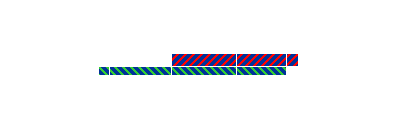
- 3 Hz to 30 Hz = ELF* (100 Mm – 10 Mm)
- 30 Hz to 300 Hz = SLF (10 Mm – 1 Mm)
- 300 Hz to 3 kHz = ULF (1 Mm – 100 km)
- 3 kHz to 30 kHz = VLF (100 km – 10 km)
- 30 kHz to 300 kHz = LF (10 km –
1 km)
- *Popular misuse calls anything from about 3 Hz to 3 kHz ELF
|
|
4
|
|
|
5
|
- Military
- Navigation Signals
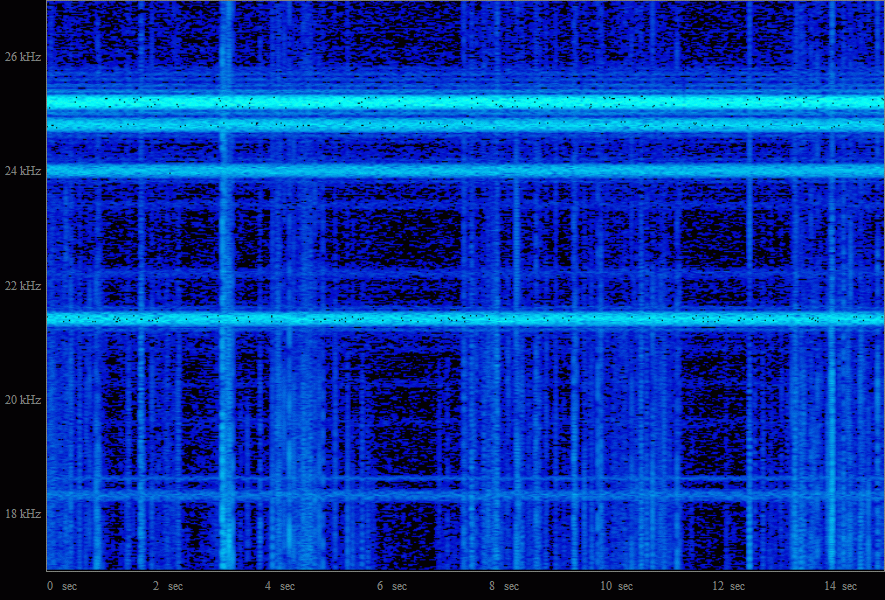
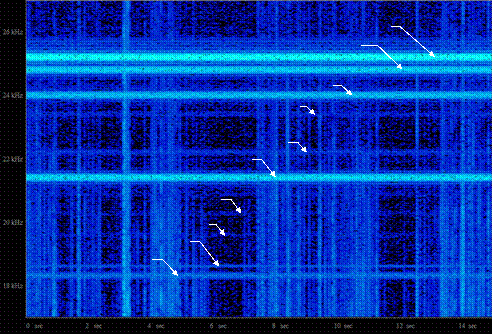
- TV Horizontal Sync. Oscillators
- The Power Grid!
|
|
6
|
- Mostly MSK (Minimum Shift Keying)
- Stations can be heard around the world
- Very large transmit antennas but small receive antennas
|
|
7
|
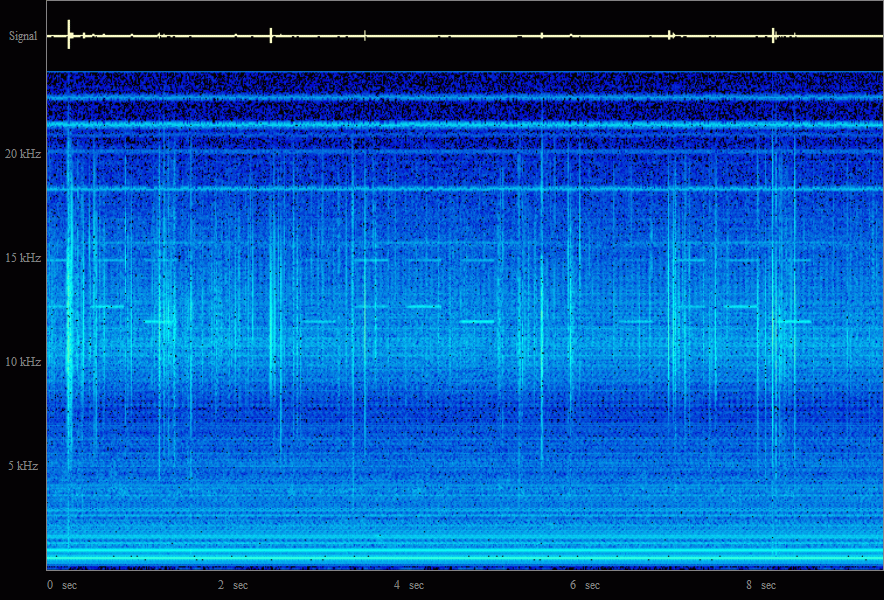
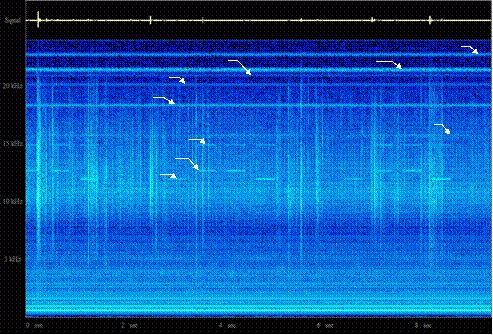
- Omega Navigation – U.S.A but off line now
- Alpha System (RSDN-20)
- Three Russian transmitters near Novosibirsk, Krasnodar and Seyda
- Frequencies of 11.905 kHz, 12.649 kHz and 14.881 kHz
- Easily heard in U.S.A with simple equipment.
|
|
8
|
- 15.734 kHz carrier (NTSC) U.S.A.
- 15.625 kHz carrier (PAL)
- Mostly from older CRT televisions
|
|
9
|
- The 60 Hz (50 Hz in many other countries) is a major source of RFI
- 50/60 Hz easily filtered but harmonics are not.
- Harmonics to a few kHz
- New DSP filters have been very successful at generating comb filters to
remove power grid RFI with minimum distortion of desired signals
|
|
10
|
|
|
11
|
|
|
12
|
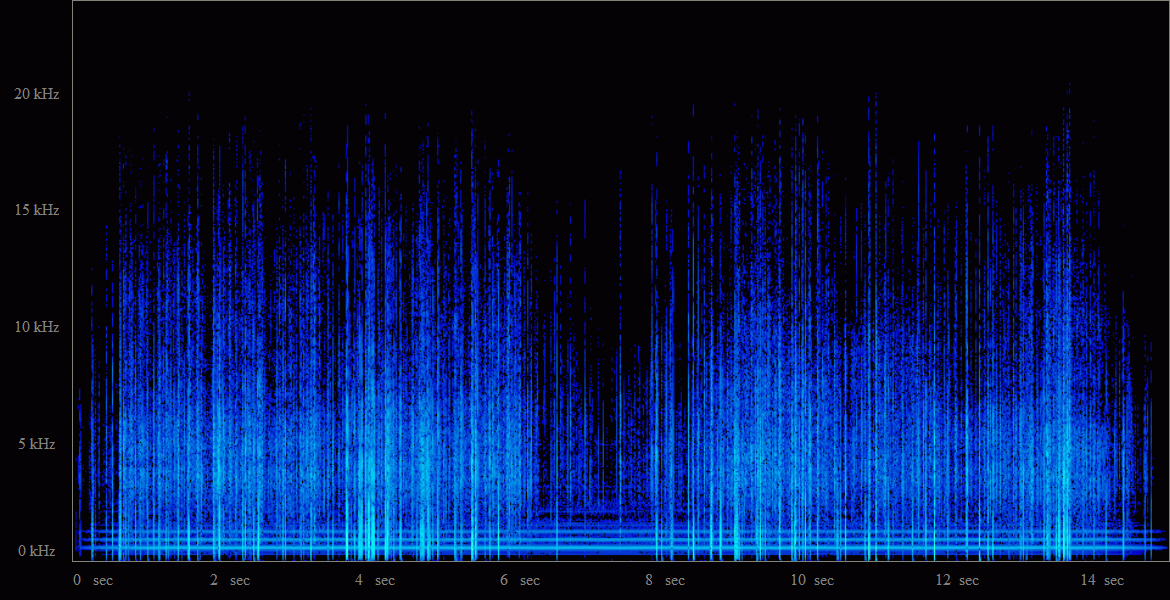
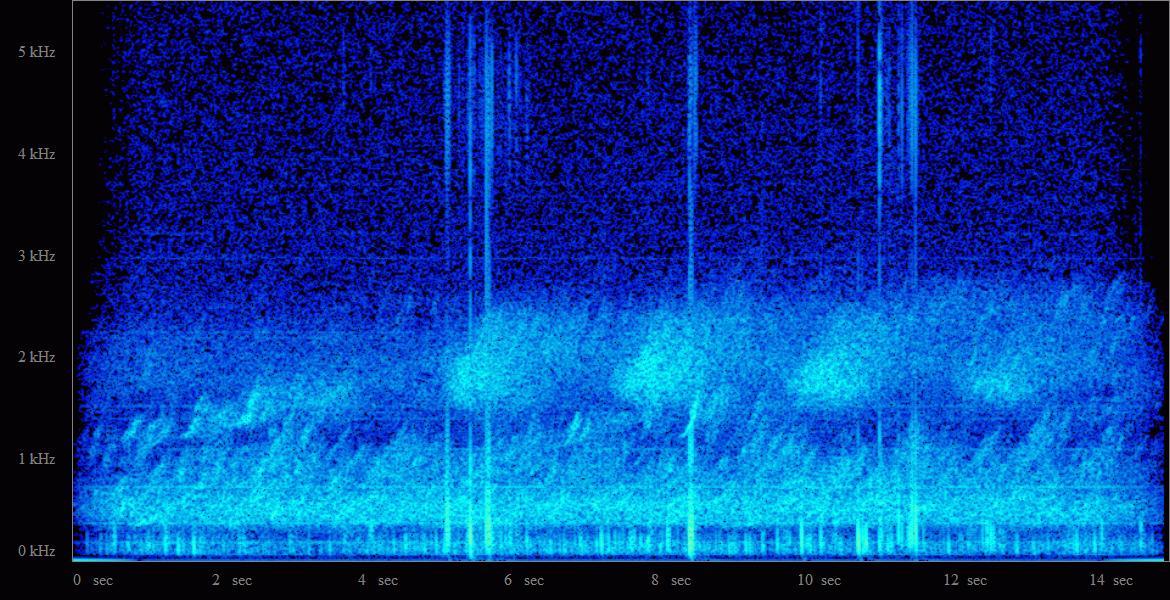
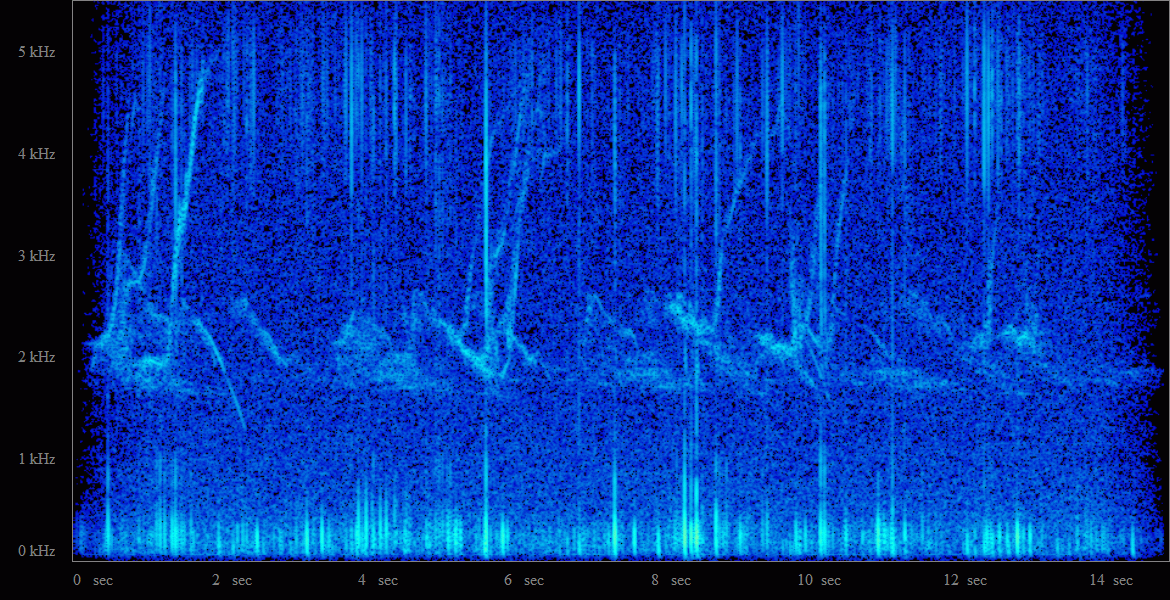
- ‘Spherics
- Tweaks
- Whistlers
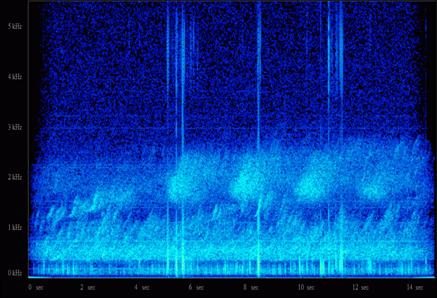
- Dawn Chorus
|
|
13
|
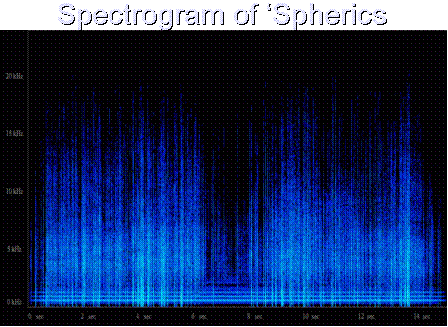
- Atmospheric signals created by the Earth’s lightning activity
- Can be heard for thousands of miles via ground wave and/or sky wave at
night
|
|
14
|
|
|
15
|
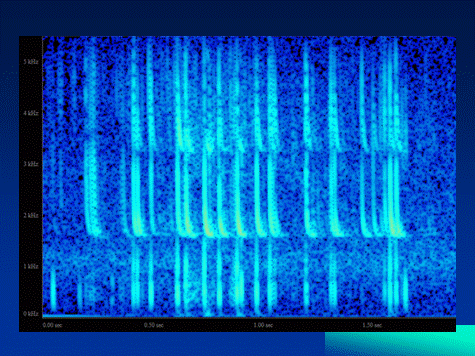
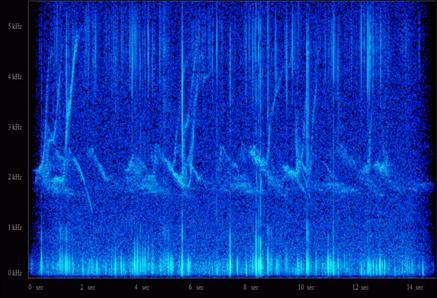
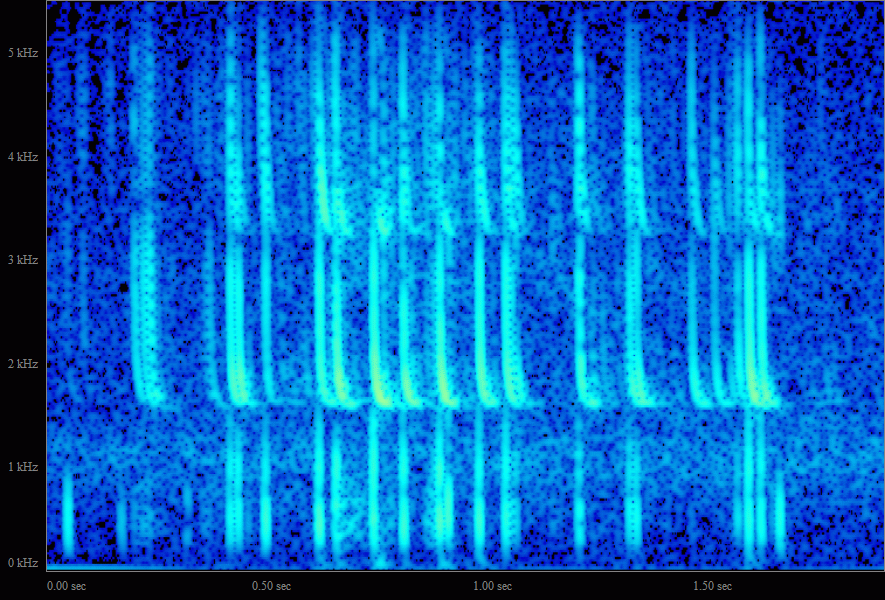
- Created by the ionosphere “wave guide” cut-off effect of broad band
lightning emissions
- At cut-off, usually about 3 kHz, there is a dispersive effect that
causes the frequencies just above cut-off to be delayed in time,
creating a “tweak” sound
- Cut-off wave length about 100 km. Ionosphere e-layer?
- May have interesting HF propagation prediction possibilities
|
|
16
|
|
|
17
|
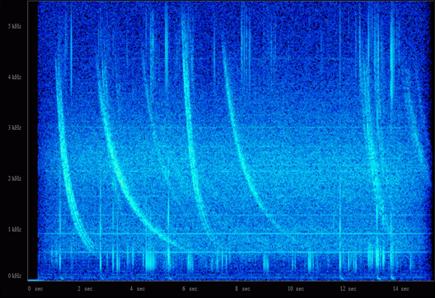
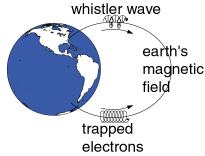
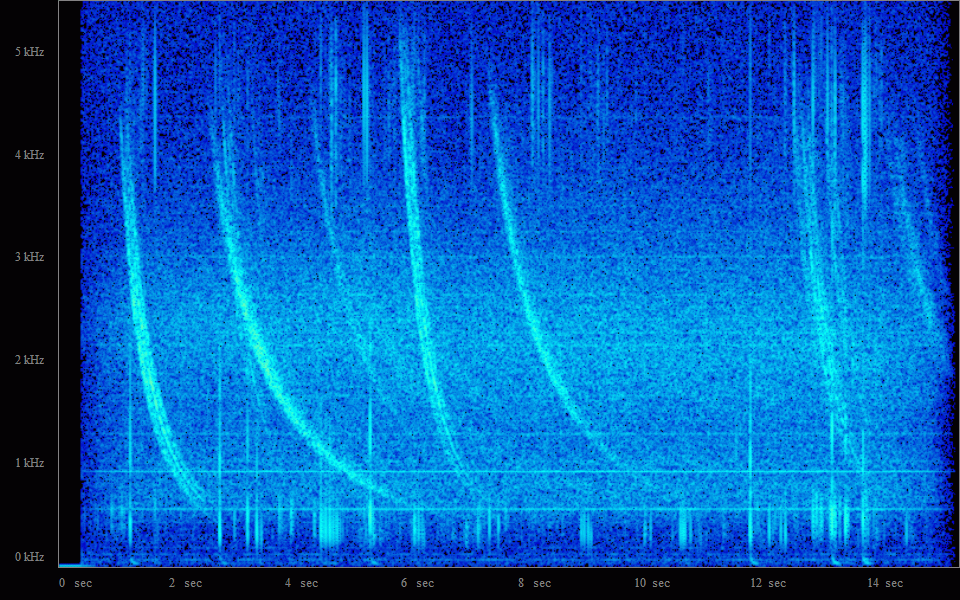
- A slow musical note beginning at high frequencies and dropping to low
frequencies over a few seconds
- Caused by broad band lightning emissions being propagated in the Earth’s
plasmasphere along magnetic field lines.
The longer the wavelength, the slower the propagation is through
the dispersive plasma paths. Hence, high frequencies arrive first
|
|
18
|
|
|
19
|
- Sounds like birds in the morning
- Mostly heard around dawn
|
|
20
|
|
|
21
|
- Noises
- Maybe aurora activity and/or geomagnetic storms
- Maybe meteor activity [14]
- Maybe earthquake activity (piezoelectric effect) [11]
- Multitude of man made devices such as electric motors, etc.
|
|
22
|
|
|
23
|
- Need to convert electromagnetic (radio) waves in recordable or audible
signals.
- Sample the E-Field or the H-Field and drive an audio amplifier or a
computer’s sound card
- Superheterodyne receiver
- Big antennas not needed for receive only applications
|
|
24
|
- Detects the electric field of the EM wave
- Relatively short whip connected to a very high impedance, voltage
amplifier
- Simple ground, such as 1 foot stake or your body
- Beware of capacitance from whip to other objects
- Very simple and portable setup.
|
|
25
|
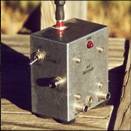
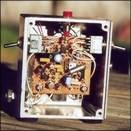
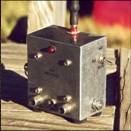
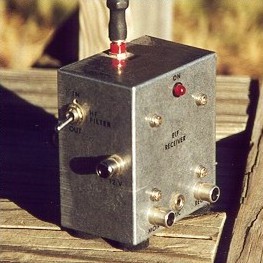
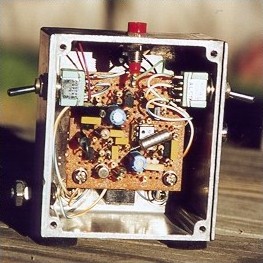
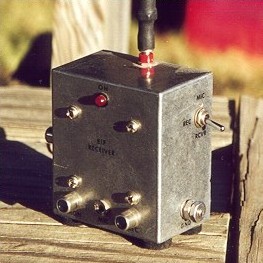
- Inspire Receiver – Home brewed based on original NASA Inspire project
design
|
|
26
|
- VLF-3 – Latest NASA Inspire project kit
- $80.00 USD
- http://image.gsfc.nasa.gov/poetry/inspire/2007/VLF3RadioReceiver.htm
|
|
27
|
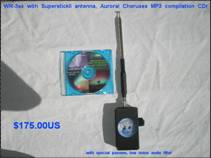
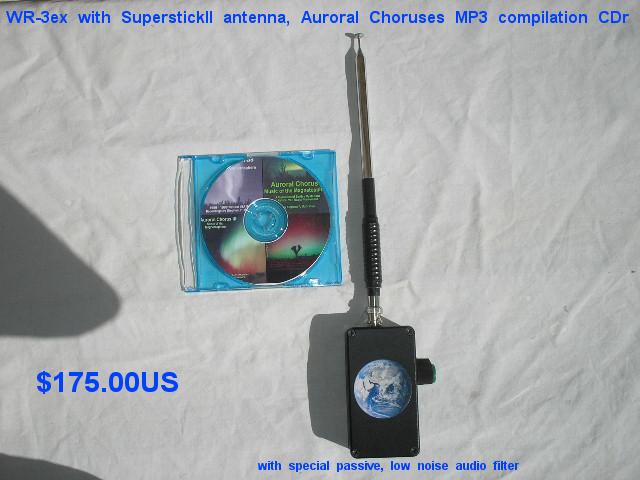
- WR-3 Receiver by Stephen McGreevy, N6NKS http://www.auroralchorus.com/wr3.htm
|
|
28
|
- Detects the magnetic field of the EM wave
- A low impedance loop driving a current amplifier
- Useful bi-directional pattern
- Perpendicular loops may drive left and right channels for cool “stereo”
effect
|
|
29
|
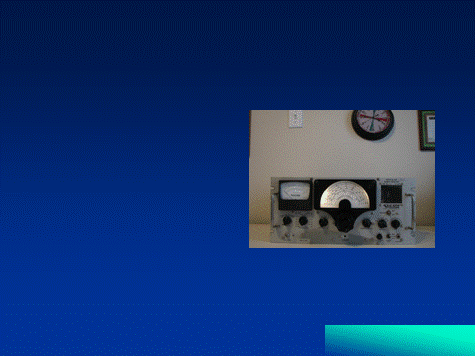
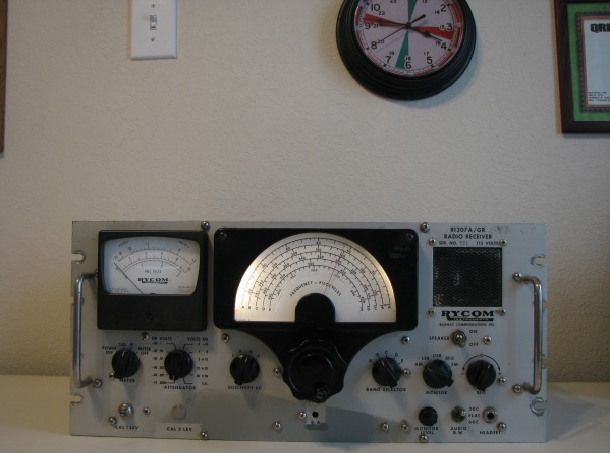
- Rycom R1307A/GR Receiver
- http://www.aa5tb.com/rycom.html
- 3 kHz to 830 kHz
- Modes: AM, CW, MCW, SSB, FM and FSK
|
|
30
|
- Any battery powered audio amplifier will usually suffice
- Any connection to earth may introduce hum due to ground loop
- Computer sound card is great
- Either isolate the line from computer or keep the computer floating
(battery powered)
|
|
31
|
- Computer preferred but can use old tape recorder.
- Sound card applications such as Audacity
- Don’t use devices or applications with AGC due to pumping by ‘spherics
- 48 kHz sampling rate allows for 24 kHz bandwidth recording (Nyquist)
- .wav files uncompressed with no loss
- .mp3 files compression but much smaller but some loss
|
|
32
|
- Audacity
- http://audacity.sourceforge.net/
- Free!
- Very good editing capabilities
- Works on most OS platforms (ex. Linux, Windows, Mac, etc.)
- Saves in various formats, including .wav and .mp3
|
|
33
|
- Spectrum Lab – by DL4YHF
- http://freenet-homepage.de/dl4yhf/spectra1.html
- Free!
- Very user configurable
- Complex but user groups available
- Windows Vista incompatible (at least for me)
|
|
34
|
- Spectrogram Ver. 15 – by Richard Horne
- http://www.visualizationsoftware.com/gram.html
- $29.95 USD
- Very user friendly and simple to use
- Microsoft Vista compatible
|
|
35
|
- ARGO by I2PHD and IK2CZZ
- http://digilander.libero.it/i2phd/argo/index.html
- Software for decoding QRSS signals
- A good tool for extreme QRP!
|
|
36
|
- 71.6 - 74.4 kHz – U.K. allocation
- Mostly for cave communications using induction rather then radio
- 135.7-137.8 kHz – 2200m Band
- Approved at the World Radio Communication Conference (WRC-07) for world
wide use but not by FCC
- Many stations active, mostly in UK and Canada
- Many use ARGO, by I2PHD and IK2CZZ - Software for decoding QRSS signals
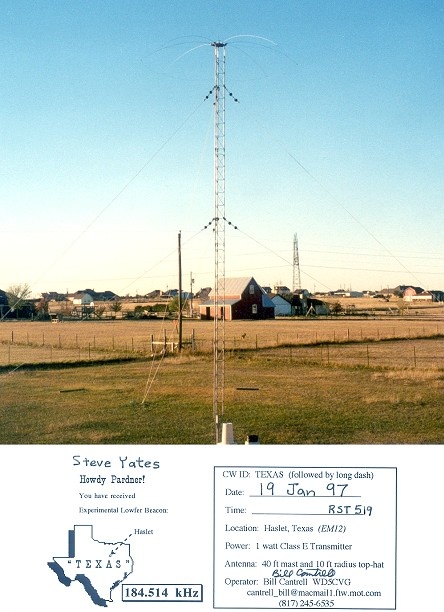
- 160-190 kHz – LowFER (Low-Frequency Experimental Radio) Band (Real
QRPp!)
- License free operation under FCC Part 15.217
- Limit 1W DC input to the PA
- Maximum 15m of antenna, ground
lead, and feedline together!
|
|
37
|
|
|
38
|
|
|
39
|
- Welcome to the Realm of Natural VLF Radio Phenomena, by Stephen
McGreevy, N6NKS - http://www.spaceweathersounds.com/
- LWCA – Long Wave Club of America - http://www.lwca.org/
- IK1QFK, Renato Romero Home Page - Exploring ULF-ELF and VLF radio band -
http://www.vlf.it/
- NASA Inspire Project - http://image.gsfc.nasa.gov/poetry/inspire/
- VLF_Group – Natural Radio VLF Discussion Group - http://tech.groups.yahoo.com/group/VLF_Group/
- Stanford VLF Group - http://www-star.stanford.edu/~vlf/Welcome.html
- VLF-3 – Latest NASA Inspire project kit - http://image.gsfc.nasa.gov/poetry/inspire/2007/VLF3RadioReceiver.htm
- WR-3 Receiver, by Stephen McGreevy, N6NKS - http://www.auroralchorus.com/wr3.htm
- Audacity Sound Editor - http://audacity.sourceforge.net/
- Spectrum Lab, by DL4YHF - http://freenet-homepage.de/dl4yhf/spectra1.html
- Spectrogram Version. 15, by Richard Horne - http://www.visualizationsoftware.com/gram.html
- ARGO QRSS Software, by I2PHD and IK2CZZ - http://digilander.libero.it/i2phd/argo/index.html
- WD2XSH - THE ARRL 600 METER EXPERIMENTAL GROUP - http://500kc.com/
- Longwave Operations, AA5TB - http://www.aa5tb.com/longwave.html
- Rycom R1307A/GR Receiver, by AA5TB - http://www.aa5tb.com/rycom.html
|
|
40
|
- [Chang and Helliwell, 1980] Chang, Donald C. and Helliwell, Robert A., VLF
Pulse Propagation in the Magnetosphere. IEEE Transactions on Antennas
and Propagation. pp. 170-176. Vol. AP-28, No. 2, 1980
- [Cohen]. Cohen, Morris, Stanford VLF Remote Sensing. Stanford University
- [Cohen, 2006] Cohen, Morris, Narrowband Transmitter Guide. The Stanford
University ELF/VLF Receiver. Stanford University, 2006
- [Gallett,1959] Gallett, Robert M., The Very Low-Frequency Emissions
Generated in the Earth’s Exosphere”. Proceedings of the IRE. Pp.
211-231, 1959
- [Helliwell and Morgan, 1959] Helliwell, R. A. and Morgan, M. G.,
Atmospheric Whistlers. Proceedings of the IRE. Pp. 200-208, 1959
- [Inan et al.,] Inan, U. S., Cohen, M. B., Scherrer, P. H., and Scherrer, D., VLF Remote Sensing
of the Lower Ionosphere: Solar Flares, Electron Precipitation, Sprites,
and Giant χ-ray Flares”. Stanford University
- [Johnson, 2000] Johnson, Michael P., VLF Imaging of Lightning-Induced
Ionospheric Disturbances. Stanford University. PhD Dissertation, 2000
- [Laasphere et al., 1963] Laasphere, T., Morgan, M. G and Johnson, W. C.,
Some Results of Five Years of Whistler Observations from Labrador to
Antarctica. Proceedings of the IEEE. Pp. 554-568, 1963
- [Laasphere et al., 1964] Laasphere, T., Morgan, M. G and Johnson, W. C.,
Chorus, Hiss, and Other Audio-Frequency Emissions at Stations of the
Whistlers-East Network. Proceedings of the IEEE. Pp. 1331-1349, 1964
- [Mohr and Gross] Mohr, Bernard and Gross, Stanley, Space Antennas for
Whistler Reception. Airborne Instruments Laboratory. Pp. 128-133
- [Ozaki et al., 2004] Ozaki, M., Nagano, I., Yagitani, S. and Miyamura,
K., Ionospheric Propagation of ELF/VLF Waves Radiated from Earthquake.
Graduate School of Natural Science and Technology, Kanazawa University.
Pp. 539-542, 2004
- [Potter, 1951] Potter, Ralph K., Analysis of Audio-Frequency
Atmospherics. Proceedings of the I.R.E. pp. 1067-1069, 1951
- [Poulsen, 1991] Poulsen, William L., Modeling of Very Low Frequency Wave
Propagation and Scattering Within the Earth-Ionosphere Waveguide in the
Presence of Lower Ionosphereic Disturbances, PhD Thesis Dissertation,
Stanford University, 1991
- [Price and Blum, 2000] Price, Colin and Blum, Moshe, ELF/VLF Radiation
Produced By The 1999 Leonid Meteors. Department of Geophysics and
Planetary Science, Tel Aviv University. Pp. 545-548, 2000
|
|
41
|
|

 Notes
Notes