I have always been interested in radio telegraphy (CW). Over the years I've acquired a few instruments of the trade. I wouldn't call my telegraph keys a true "collection" yet but I thought I'd share what I do have.
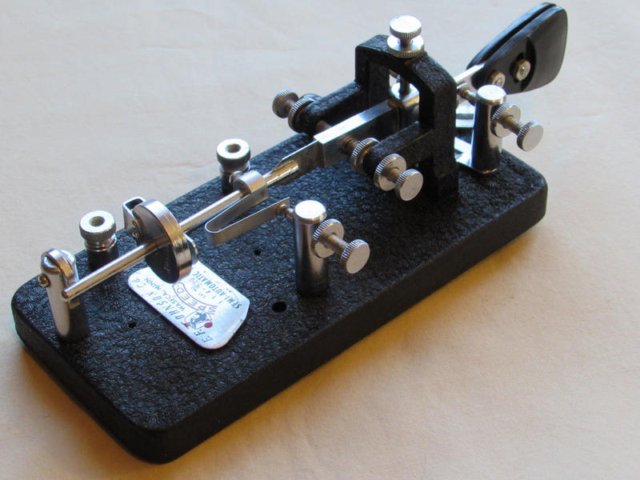
I acquired this semi-automatic (bug) telegraph key in January of 2014. Before this bug I had always used either my Bencher paddles and an electronic keyer or one of my straight keys. The original owner had it on display with his E.F. Johnson vintage station and hardly used it so it was in pristine condition when I received it.
Though it required me to "rewire" my brain to go from a keyer to a bug, I have since become hooked on it. It runs at speeds from about 22 to 50 wpm. Below 22 wpm I simply used the "dah" paddle to send like it is a straight key.
I have used it everyday since I got it and during several contests so I hope that I have become fairly proficient at sending with it. I try hard not to sound like some bug users with a banana boat swing or worse. Here is a link to a short clip of a holiday message that I sent with it: A Message for You
This particular bug is nice in that it can be screwed to the table which helps tremendously.
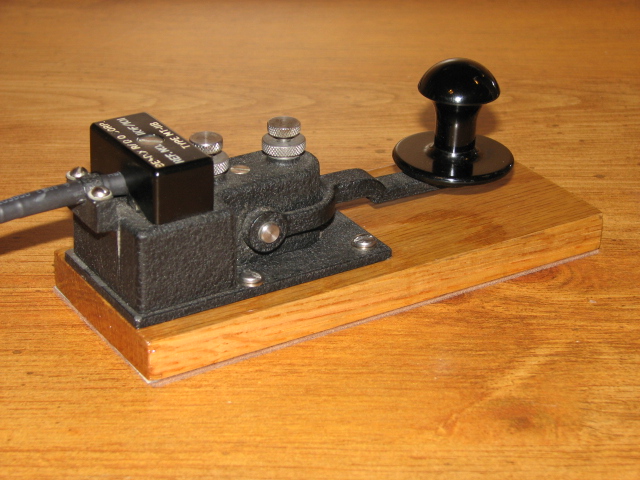
I recently acquired this fine key from my friend Joe, KK5NA in trade for my Kent Key below. It was made by the Bendix Radio Corporation for use on ships and aircraft I believe and is of World War II vintage. It is marked with a reference number of 110F-101 and says Type MT-11B. I've seen a lot of these around but never in this good of shape. It even has the original shielded cord and connector but since the cord was about as flexible as RG-8 coax I removed and stored it and put something more practical on it for use.
I mounted the key on a piece of polyurethane coated oak and put a piece of leather on the bottom to keep it from sliding around. This has been a fine key and it has seen a lot of use in my shack.
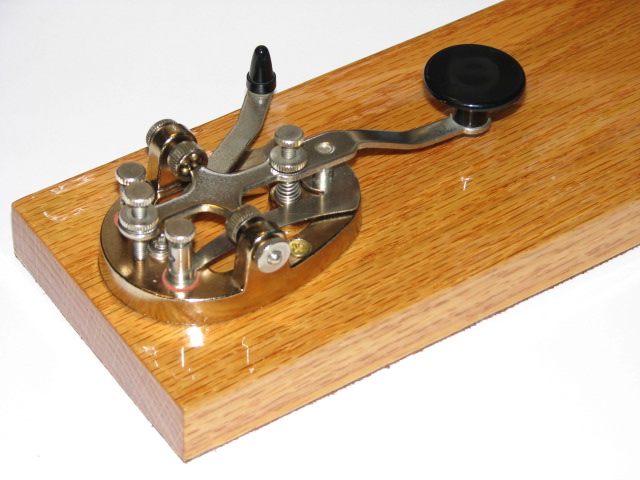
This key was made in Japan for Radio Shack for many years. It was my first key as a novice back in the 1970's. I always thought it was kind of cheaply made and I haven't used it much after acquiring my first J-38. However, after mounting it on a nice piece of oak and spending some time filing the arm's pivot joint to remove burrs and fine tuning the ball bearing adjustments I must say that this key shines up very nicely. I attached leather to the bottom of the oak and the whole assembly is relatively light yet stays put on the table. If you are looking for a inexpensive key for everyday use you might consider finding one of these and doing the same. This key is still sold today by Milestone Technologies as an Ameco Brass Key AM-K4.
Below is the same key mounted on a $1.00 piece of wood from Hobby Lobby after several coats of polyurethane.
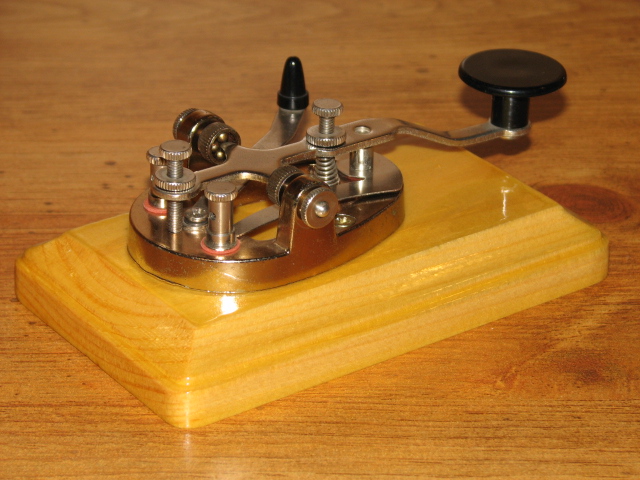
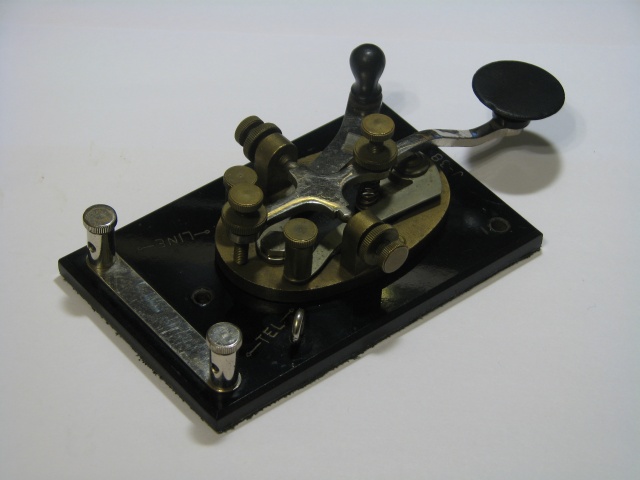
I acquired this J-38 key in the late 1980's. It had belonged to my friend Richard Hall, W5ZJG. He and I were radio operators at the coast station WFE in Houston. When he became a silent key the key was given to me. I believe the key had once belong to his father who was also a ham. I know it is very old. It has been used so much that the knob is wore very thin and the arm is slightly bent.
I do not know what company manufactured this one. There were many companies contracted to manufacture the J-38 for the U.S. military as I understand it. All I know is that this one is mostly brass except for the chrome plated steel arm, non-brass rear binding posts, and non-brass shorting bar. It has a very nice feel and good, solid click of the contacts. I have used this key very much. I recently attached a piece of leather to the bottom with the soft fuzzy side out and the key "clues" itself to the table.
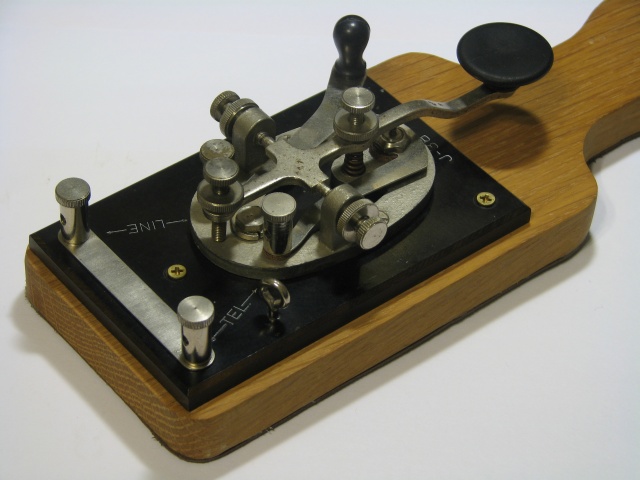
I purchased this key from an antique store in Mena, Arkansas around 2000. It was very dirty and mounted on a piece old wood with a homebrew code practice oscillator. I suspect it had belonged to a ham but who knows when. I disassembled the key and carefully cleaned it up. In reality it was in pretty good shape. I mounted it on a oak "paddle". I use it quite a bit but it doesn't feel as good as my other J-38. The "anvil" and "hammer" contacts seem to be kind of soft for some reason but it is probably just different.
I do not know the manufacturer of this J-38 either but it resembles what K6IX calls a White Metal type. I think that the frame is made of nickel or at least heavily plated in nickel. This J-38 seems to be a bit rare.
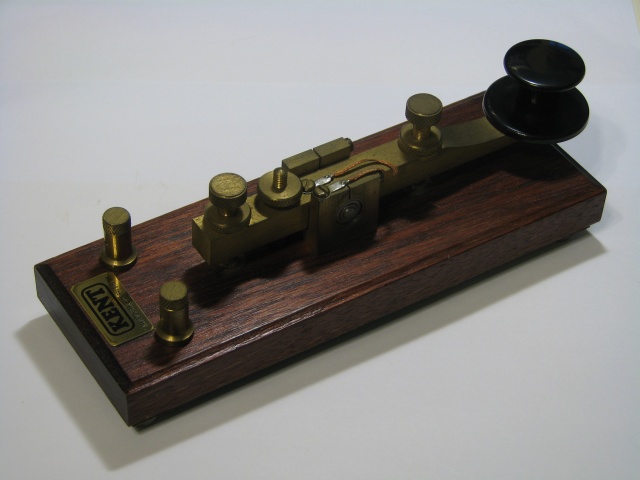
I purchased this Kent straight key from England in 1994 and it came in kit form. I completed the key on June 11, 1994. It is very similar to the type of key that was used on the Titanic. It is a nice key but the "anvil" and "hammer" contacts seem to have a bit of a bounce to them that may cause problems in some transmitters. It would probably work good with a spark transmitter since it has contacts on it that look like they could handle a 30 amps!
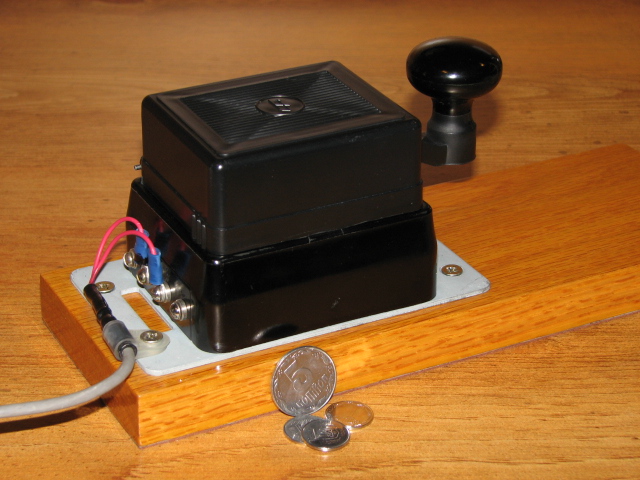
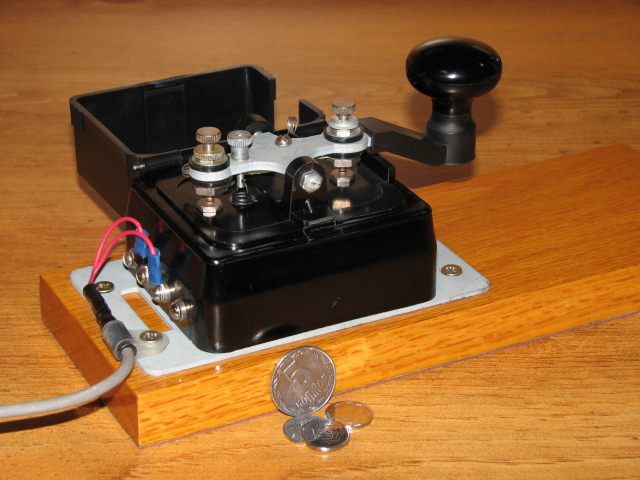
This is my Soviet TKF key manufactured by Cherkassy Telegraph Equipment in Ukraine between about 1988 and 1992. It includes a built in LC anti-sparking filter. These keys were constructed for the Soviet military and Arctic weather stations but this one was never delivered due to the fall of the Soviet Union. I obtained this key new in the box directly from Ukraine in 2007. It is said that the manufacturer has lost all of it's technological facilities and will never be able to make these keys anymore.
Believe it or not, I can send good CW at 25 WPM with this key. One would think that such a massive key couldn't more very fast but there is something about it that allows me to keep a good "beat". I put some leather on the bottom of it and it stays put.
Notice that this key has electrical contacts at both the rear and front of the arm to allow either normally closed contacts or normally open contacts. I don't know what the original use of the dual set of contacts was for but it would be ideal for a full break-in QSK rig or for the time sequenced keying of a microwave transverter to prevent damage to LNA's.
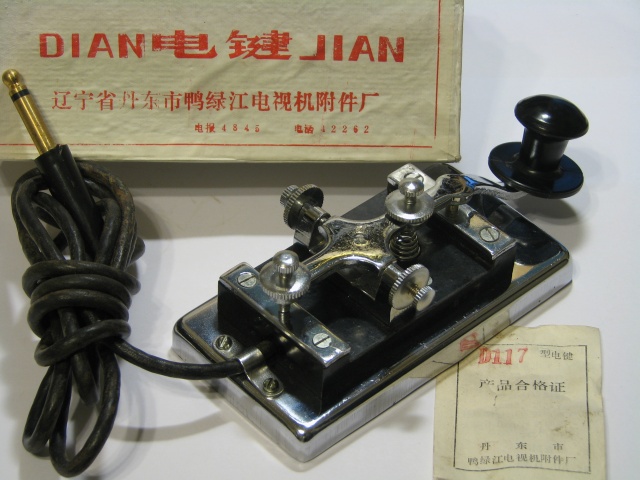
I purchased this heavy key from a distributor in California in 2008 for a very low price. It was brand new old stock still in the box. It was supposedly developed for the People's Liberation Army (PLA). It is very heavy duty and makes for a good work horse key. It is not very refined so you won't feel bad if you get a few scratches on it. When I first tried it out, the felt on the bottom of the base was recessed too far and the "shell" would rest on the table. This was slightly unlevel and caused movement during the key's operation. I removed the original felt and installed thick leather in its place. Now the heavy key doesn't move at all while sending.
There is a popular American telegraph key vendor still selling these type of telegraph keys for a much higher price but they say "They are still expensive to ship from China, of course, but we are happy to pass the savings along to our customers". Since everything we get here in the U.S. is from China I don't think shipping is an issue ;-)
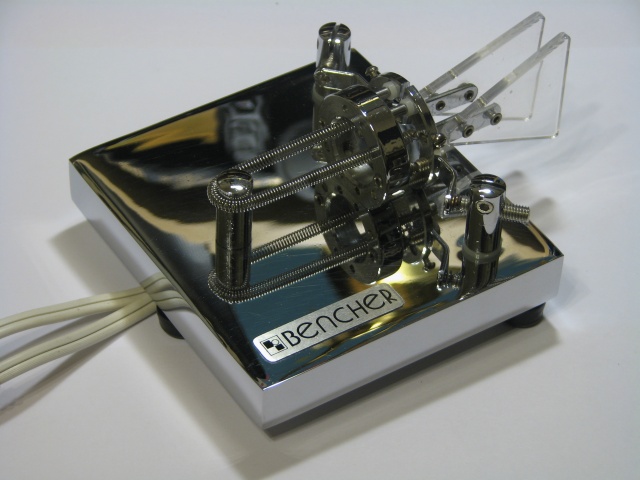
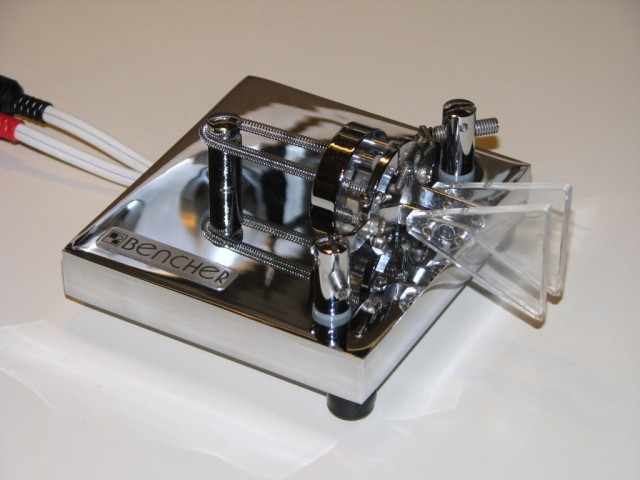
Here are my Bencher paddles. I received these as a Christmas gift from my wife many years ago. These have been my "work horse" for radio telegraphy.
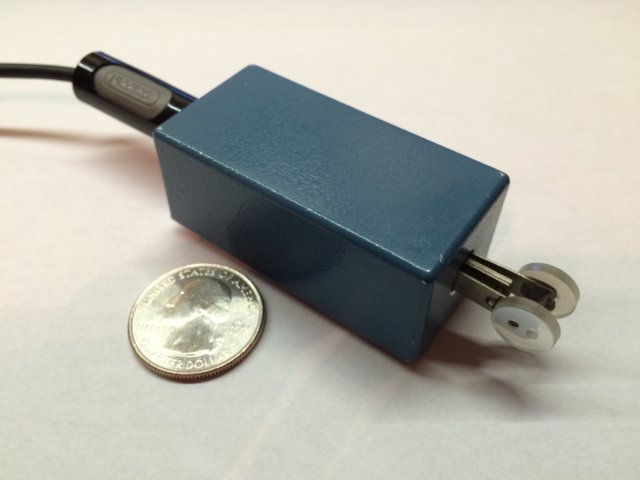
I take my CW gear out to the field every chance that I get. When operating portable size and ruggedness are major concerns. I built the following set of paddles to meet my needs for field operating.
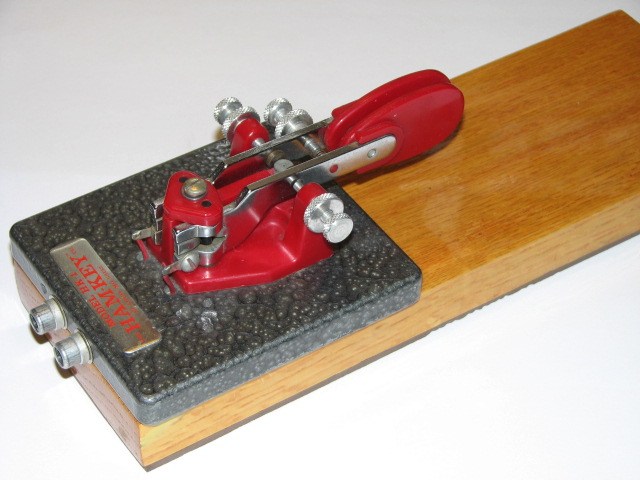
I purchased these Ham-Key Model HK-1 paddles some time around 1981 I believe. I put a lot of entries into my log with these paddles. With the original feet I had a problem with the paddles sliding around on the table so I took the feet off and mounted them on a solid piece of oak. I then clued some foam pad on the bottom side and with my arm resting on the wood they stay put no matter how hard I bang them.
After acquiring my Bencher paddles these have been only used at Field Day or other activities that may be too harsh for the Benchers.
